That Sneaky “de”: One Sound, Three Musketeers
Nail the difference between 的, 地, and 得 — and sound like a language ninja while having a good laugh at my own blunders trying to keep them straight.
Subtitle: Nail the difference between 的, 地, and 得de, de, de · connector particle, adverbial particle, complement particle — and sound like a language ninja while having a good laugh at my own blunders.
📚 What’s the Trick About?
I still remember the long silence after I texted my Chinese roommate: “我开心的跳了起来!wǒ kāixīn de tiào le qǐlái · I happily jumped up” She just stared at the screen, then at me, and said, “You jumped up… but not in a 地de · adverbial particle way.” I had no clue what the grammar police were on about. I just wanted to say I jumped happily.
That’s when I discovered the secret gang of Mandarin: 的, 地, and 得de, de, de · connector particle, adverbial particle, complement particle. Three tiny characters, all pronounced “de”, but each with a fiercely different job. They look like triplets wearing the same name tag, and trust me, they love playing tricks on foreign learners.
Here’s something I wish I knew earlier: mastering this trio isn’t about being a perfectionist. It’s the moment your Chinese stops sounding like a robot and starts feeling like you.
🔍 Let’s Break It Down
Let’s imagine three friends who all answer to “de.” They might sound the same, but their personalities couldn’t be more different.
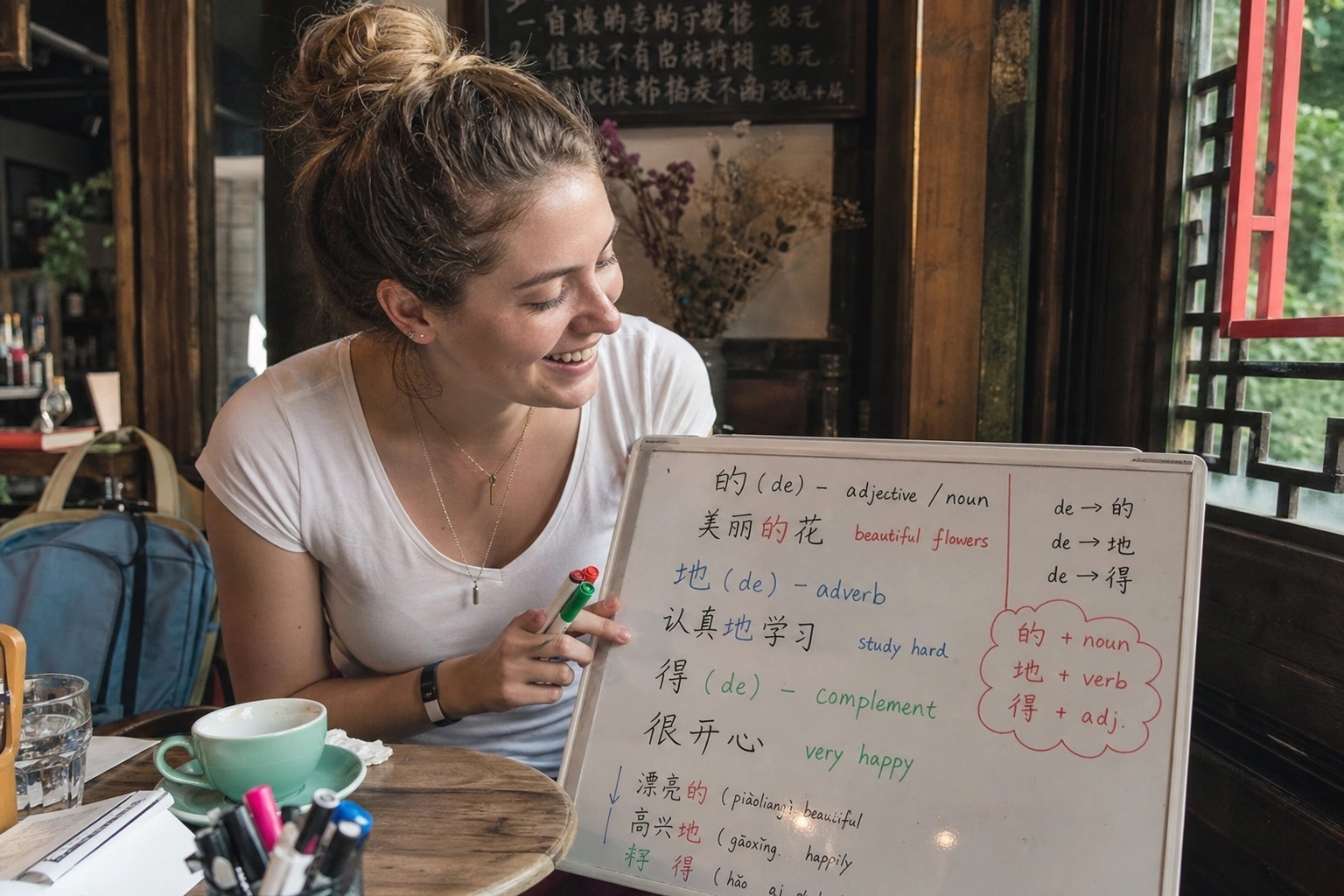
- 的de · connector particle — The Connector (and my first love). Think of 的de · connector particle as the friendly glue between an adjective and a noun, or a possessive marker. It’s the “’s” or “of” in English. My first sentence was 我的猫wǒ de māo · my cat, and I felt unstoppable.
- 地de · adverbial particle — The Action Stylist. This one turns an adjective into an adverb. It’s your “-ly” maker. It decorates verbs, telling you how something is done. Remember my jump? It should have been 开心地跳了起来kāixīn de tiào le qǐlái · jumped up happily — joyfully jumped. No wonder my roommate looked at me like I’d stolen the grammar.
- 得de · complement particle — The Result Reporter. This friend hangs out after a verb to show the result or degree — like “so…that” or simply “how something turned out.” When I say 我跑得很快wǒ pǎo de hěn kuài · I run fast, 得de · complement particle is judging my running and telling the world I am indeed speedy.
Pay attention to the structure:
- Adjective + 地de · adverbial particle + Verb (how you do it)
- Verb + 得de · complement particle + Description (the outcome)
- Modifier + 的de · connector particle + Noun (what type or whose)
It clicked when I started treating them like a mini formula instead of abstract grammar. Just follow the pattern, and you’ll sound refreshingly natural.
🗣️ Try These Out: Essential Phrases
| Chinese | Pinyin | English |
|---|---|---|
| 我的书 | wǒ de shū | my book |
| 可爱的小猫 | kě ài de xiǎo māo | a cute kitten |
| 高兴地唱歌 | gāo xìng de chàng gē | sing happily |
| 跑得很快 | pǎo de hěn kuài | run very fast |
| 写得真漂亮 | xiě de zhēn piào liang | write really beautifully |
| 热得满头大汗 | rè de mǎn tóu dà hàn | so hot you’re sweating buckets |
🚫 Common Pitfalls (Don’t Sweat It)
Mistake 1: Swapping 地 for 的 in a verb phrase.
I wrote 慢慢的说màn man de shuō · speak slowly with the wrong particle for months. My teacher gently corrected me: 慢慢地说màn man de shuō · speak slowly is the proper way to say “speak slowly.” Without 地de · adverbial particle, it sounds like you’re describing a slow version of speaking, rather than actually speaking slowly. Weird, right?
Mistake 2: Saying 她唱的很好听tā chàng de hěn hǎotīng · she sings beautifully, with the wrong particle instead of 她唱得很好听tā chàng de hěn hǎotīng · she sings beautifully.
You’re not describing her song (that would be 的歌), you’re evaluating how she sings. A tiny swap, but it makes your compliment accurate.
You’ll make these boo-boos, and that’s totally okay. Even native speakers mix them up in quick texts, but when you nail it in writing or speech, the reactions are priceless.
💡 One More Fun Fact
Here’s a cheeky nugget: each of these characters has a secret double life. 的dí · indeed can be dí (的确díquè · indeed, indeed), 地dì · earth/ground becomes dì (地球dìqiú · earth, earth), and 得děi · must can be děi (我必须得去wǒ bìxū děi qù · I have to go, I have to go). They only put on the “de” mask and whisper together when they’re doing their everyday grammar magic. So next time someone says there are too many “de” sounds, you can smile and tell them they’re really just three superheroes in disguise.
🥠 Keep Playing
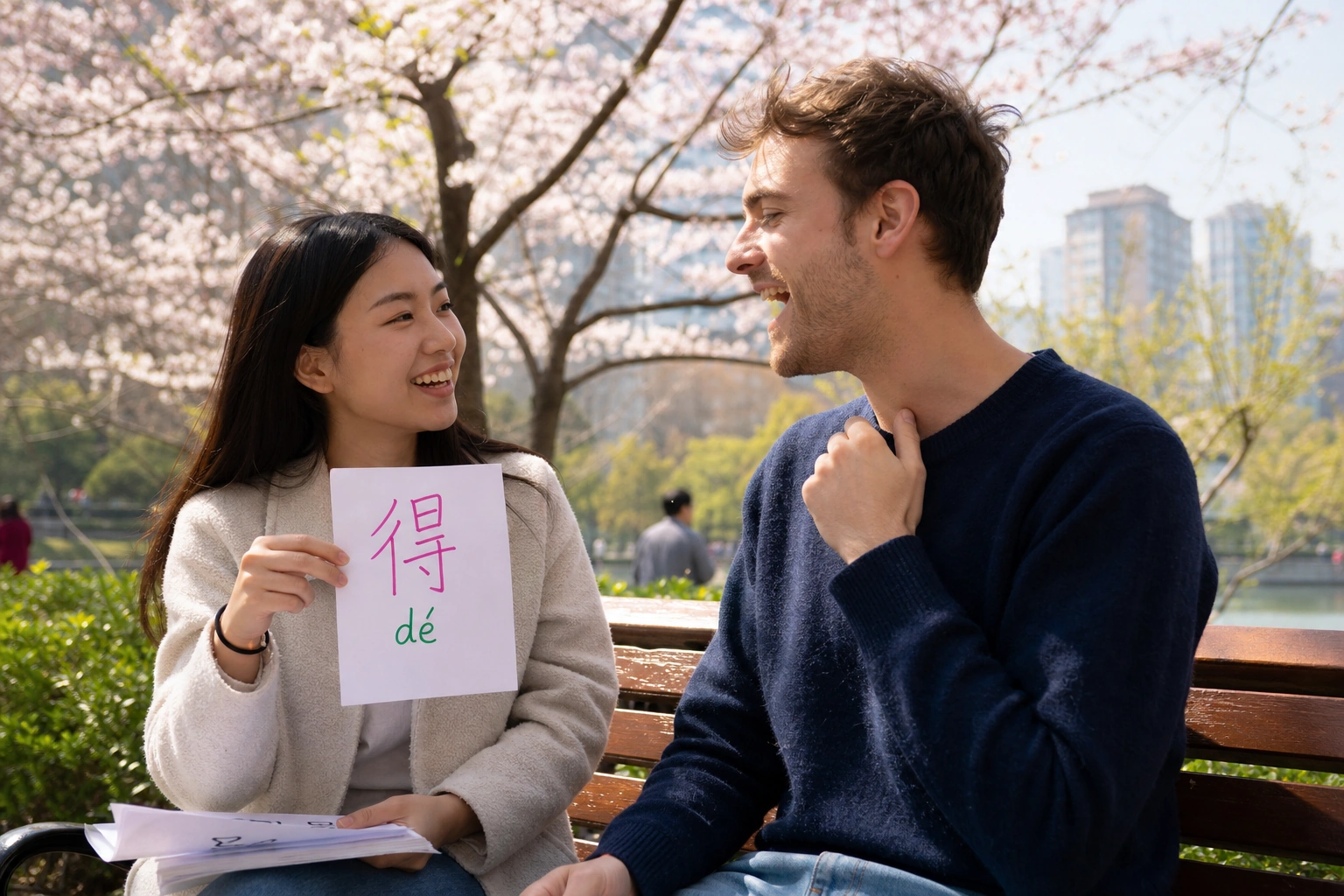
Learning the three “de” brothers feels like cracking a code, not cramming for an exam. Once you start playing with the patterns, every sentence becomes a little puzzle you know how to solve. Print out a few sticky notes with 的, 地, and 得 and stick them on your mirror — your brain will thank you.
What’s the silliest mix-up you’ve had with these sound-alikes? Drop your story in the comments — I’m sure it’ll make me laugh and feel less alone in my 地-ly adventures.

Master Chinese the right way — start with LingoTouch
You might also like
The Tiny Words That Unlock Chinese: 了、的、吧
Particles like 了, 的, and 吧 aren't just grammar dust you sprinkle randomly — they're the emotional glue of Chinese, and feeling their personalities transforms your speech.
Crack the CodeThe Day I Ordered “One Noodle”
Measure words aren't boring grammar — they're tiny picture frames for everything you say. Master a few, and your Chinese instantly feels warmer and more local.
Crack the CodeStop Memorizing 成语 — Start Watching Tiny Movies Instead
How to memorize 成语 with stories? Start watching tiny movies — 对牛弹琴, 画蛇添足, 杞人忧天, 拔苗助长. That's all interesting stories worth bingeing today.